Great product design is not a rigid sequence of steps. It is a flexible, intentional process of choosing the right methods at the right time to solve the right problem.
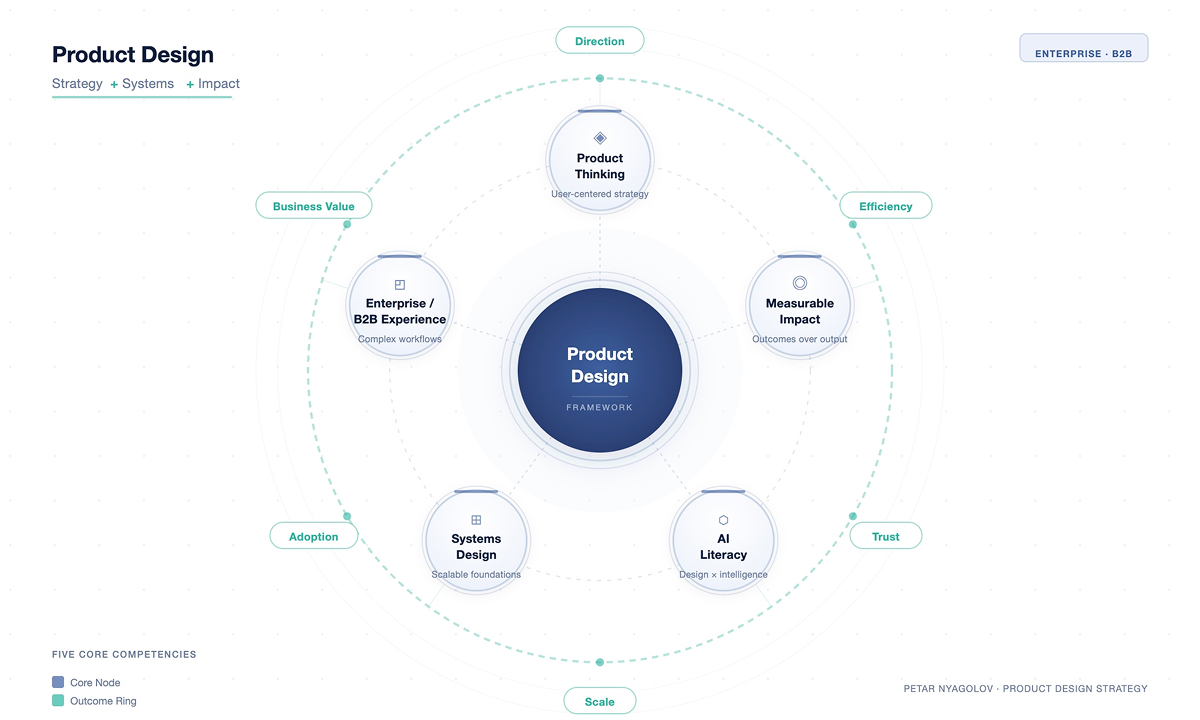
My approach combines design thinking with strong product thinking — connecting user needs, business goals, technical feasibility, and measurable outcomes. I focus on understanding the problem behind the request, defining the right product direction, and designing scalable experiences that create value for both users and the business.
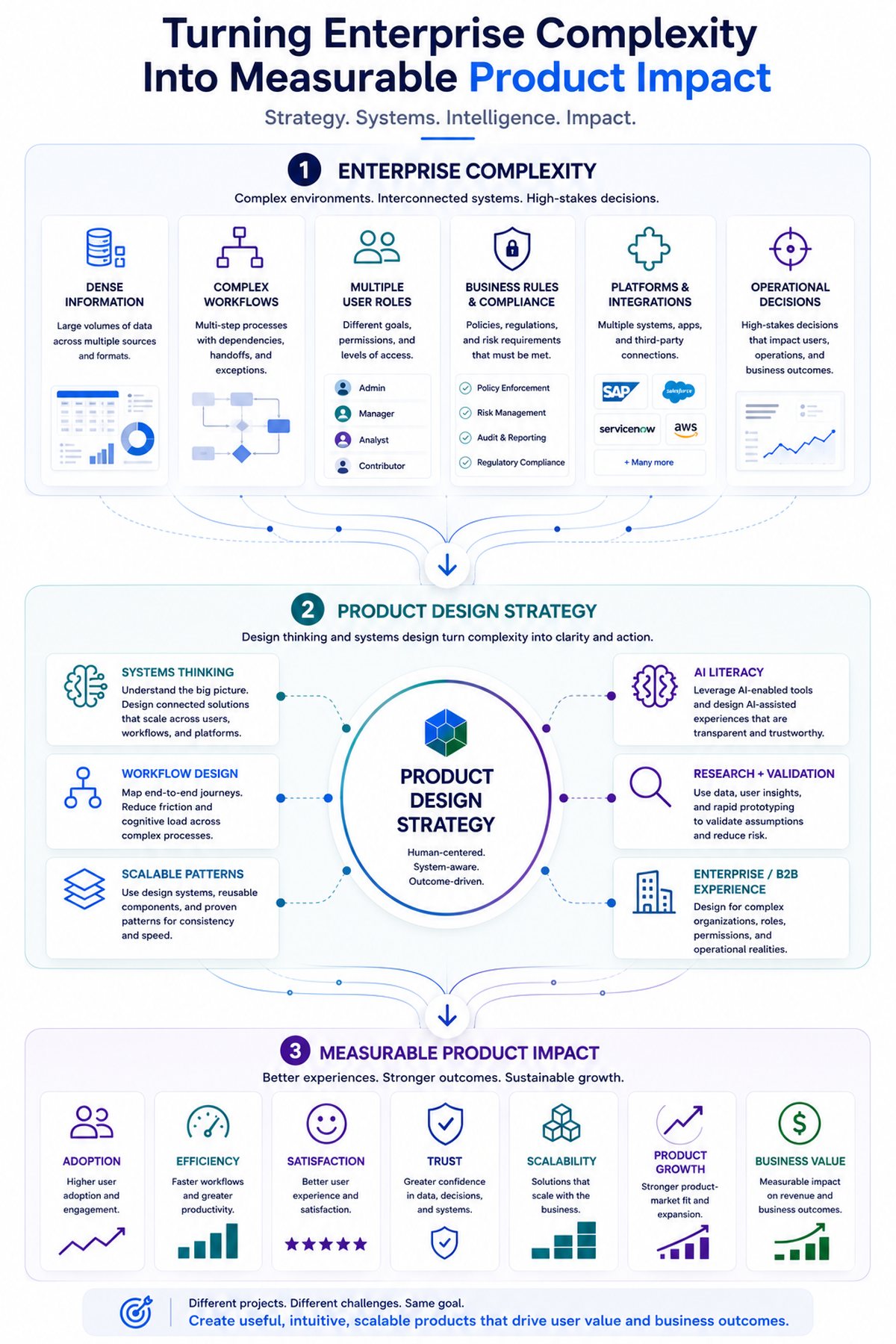
With deep experience across enterprise and B2B applications, I bring systems design thinking to complex workflows, dense information environments, and high-stakes operational tools. I consider how features connect across platforms, how users move through end-to-end processes, and how design decisions impact adoption, efficiency, satisfaction, and long-term product growth.
Understand the business objectives
Before design begins, it is critical to understand what the business is trying to achieve.
I work closely with stakeholders, product leaders, business analysts, and cross-functional teams to clarify the product vision, business goals, constraints, success metrics, and expectations. This early alignment creates a shared foundation for the entire team and helps determine the right research approach, timeline, deliverables, and product direction.
At this stage, I focus on understanding:
- What business problem are we solving?
- What outcomes does the organization need to achieve?
- Who are the users and customers affected by this product?
- What pain points are already known?
- What risks, constraints, or dependencies should we consider?
- How will success be measured?
This foundation helps ensure the design process is not just creative, but purposeful, strategic, and aligned with measurable business value.
Discover User Needs
User experience design starts with understanding the people who use the product.
Who are the users? What are they trying to accomplish? Where do they struggle today? Why are they relying on workarounds, calling support, abandoning tasks, or losing confidence in the system?
These questions require direct engagement with users, careful observation, and thoughtful analysis. I have worked closely with skilled researchers and have also led research activities directly when needed. In both cases, the purpose is the same: uncover real user needs, identify friction, validate assumptions, and create a strong foundation for product decisions.
Depending on the project, discovery may include:
- User interviews
- Stakeholder interviews
- Persona development
- Task analysis
- Workflow observation
- Journey mapping
- Current-state process mapping
- Information architecture analysis
- Heuristic evaluations
- Surveys
- Usability testing
Every research method should have a clear purpose. The goal is not to conduct research for the sake of research, but to gather the right insights at the right time so the team can make better product decisions.
Define the Experience Strategy
Once business goals and user needs are understood, I begin connecting the dots.
This is where strategy becomes design direction. I look across user research, business requirements, workflows, data structures, usability principles, technical constraints, and product goals to define a clear path forward.
As a product designer, I advocate for users while staying grounded in business priorities and technical feasibility. My role is to help the team simplify complexity, reduce unnecessary friction, and shape a product experience that is useful, scalable, and realistic to build.
This phase often includes:
- Experience principles
- Product and UX recommendations
- Workflow models
- Process diagrams
- Concept sketches
- Low-fidelity wireframes
- Rapid prototypes
- Design direction alignment
The goal is to move from scattered inputs to a clear product direction that the team can understand, evaluate, and build upon.
Validate With Users
The only way to know whether a design works is to test it with real users.
I believe in testing early, learning quickly, and improving before costly engineering decisions are made. User validation helps reduce assumptions, uncover usability issues, and confirm whether the proposed solution truly supports user goals.
I often use moderated usability testing, including scripted “think aloud” sessions, where users complete realistic tasks while sharing their thoughts. When possible, I invite product managers, business analysts, engineers, QA team members, and stakeholders to observe. This creates shared understanding and helps the team move from opinions to evidence.
Validation helps answer questions such as:
- Can users complete key tasks successfully?
- Where do they hesitate or make mistakes?
- Does the workflow match how they think and work?
- Are labels, actions, and content clear?
- Does the design reduce friction or create new complexity?
- What should be improved before development?
Testing is not just a checkpoint. It is a critical feedback loop that helps the team build the right product with greater confidence.
Collaborate With Engineering
Successful design implementation is not a handoff. It is a partnership.
While I am not a front-end engineer, I understand the importance of speaking the language of technology. Over the years, I have worked closely with engineering teams to understand feasibility, constraints, implementation details, and the practical realities of building complex software.
My preferred approach is to involve engineers early in the process, especially during discovery, conceptualization, prototyping, and validation. Early collaboration helps identify technical opportunities, reduce rework, and create a stronger bridge between design intent and production reality.
These days, I also use AI-enabled and vibe design tools to accelerate the transition from design direction to interactive prototypes. These tools help me quickly explore ideas, simulate product behavior, validate workflows, and communicate design intent in a more tangible way before full engineering implementation begins.
Depending on the project, this collaboration may include:
- Early feasibility discussions
- Design and engineering reviews
- Interactive prototypes created with AI-enabled and vibe design tools
- Interaction specifications
- Design system alignment
- Implementation documentation
- Working sessions in the browser
- QA and design validation
- Post-build design review
Clear documentation matters, but conversation matters more. The best outcomes happen when designers and engineers solve problems together.
Successful product design is a symbiotic relationship between strategy, users, design, and engineering — not just a handoff of screens.